


When you buy sanitary pads, the front of the pack may highlight words such as “cotton,” “organic,” “soft,” “breathable” or “chemical-free.” But what do those words actually tell you about the product? And what should you check if you want to know what touches your skin, what absorbs menstrual flow, or whether the pad contains added fragrance?
Reading a sanitary pad label can feel confusing because a disposable pad is usually made from several layers, each with a different job. Some product pages list only selected materials, while others provide more detail. This guide will help you read the information that is available, recognise vague claims, and ask useful questions when the composition is not clearly explained.
Start With the Whole Pad, Not Just the Front Label
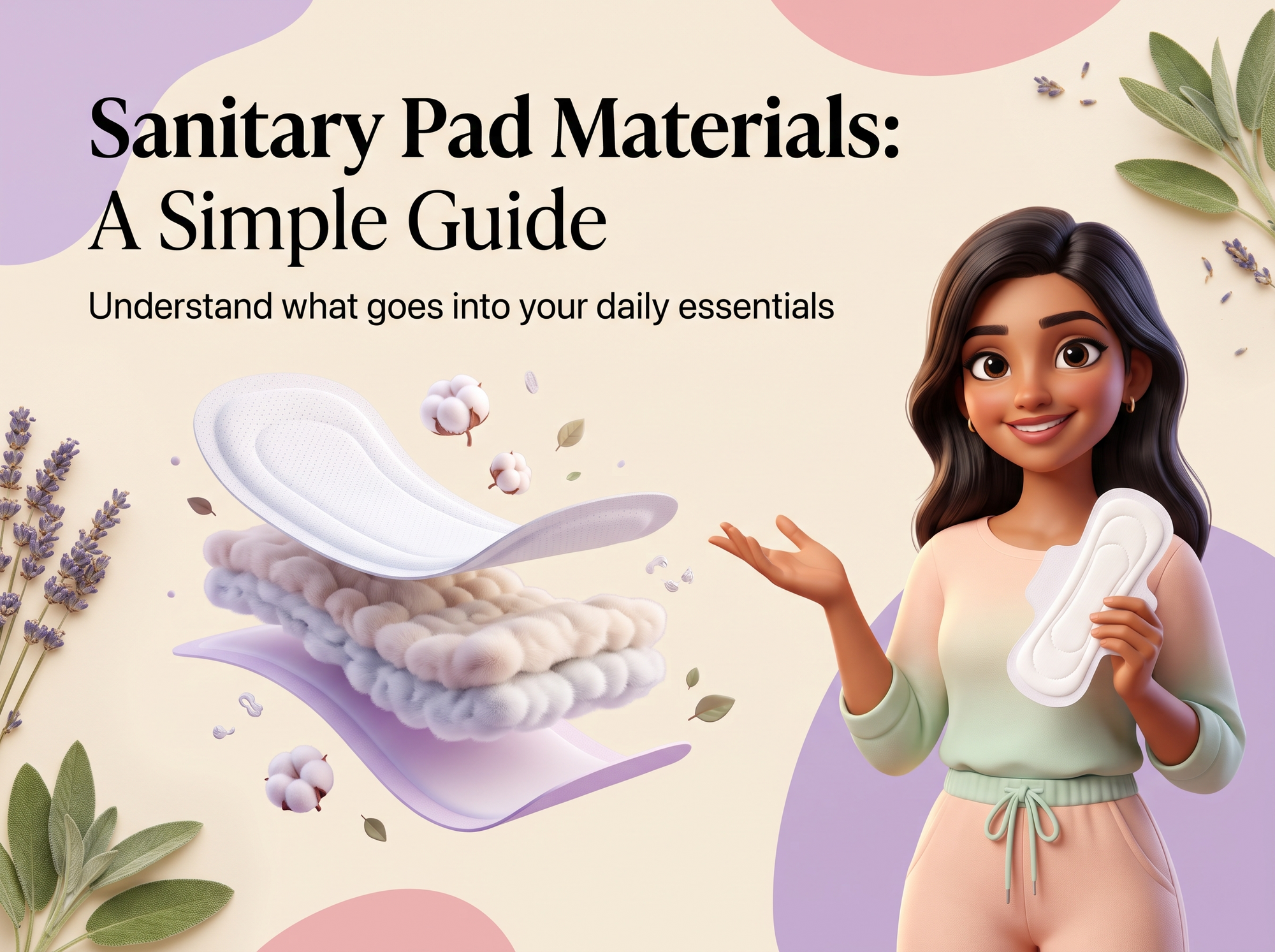
A disposable sanitary pad is not one single sheet of material. It commonly includes a top layer that touches the body, a transfer or distribution layer, an absorbent core, a leak-resistant backing and an adhesive system that helps hold the pad to underwear. Some products also include wings, a release liner and individual wrapping.
UNICEF’s technical specification for disposable sanitary pads describes these separate functions and lists examples of materials that may be used in different layers. The exact construction varies by product, so a list of possible materials should not be mistaken for the ingredient list of every pad.
When you read a product page, look for the materials of the top sheet, absorbent core and backing separately. If the brand mentions only one component—for example, an organic cotton top sheet—do not assume that every other layer is made from cotton or organic material.
What Do the Different Pad Layers Do?
1. Top sheet or skin-contact layer
This is the surface that rests against the body. Depending on the product, it may be made from cotton, viscose/rayon, polyester, polypropylene, polyethylene or a blend. If you prefer a particular fibre, look for a clear statement about the actual top sheet rather than wording such as “cottony soft,” which describes feel rather than necessarily confirming fibre content.
For a broader comparison, you can compare cotton and synthetic pad materials.
2. Transfer or distribution layer
Some designs use a layer to help move fluid from the surface toward the absorbent core. The material and design can vary. Product pages may not always disclose this layer separately, so ask the manufacturer if the information is important to you.
3. Absorbent core
The core holds menstrual fluid. It may use cellulose-based materials, such as pulp, and some designs may include superabsorbent polymers (often abbreviated as SAP) to help absorb and retain fluid. The presence or absence of a specific material should be confirmed from the product’s own documentation, not guessed from its thickness.
4. Leak-resistant backing
The bottom layer helps reduce leakage through the pad. Some disposable pads use plastic films such as polyethylene or polypropylene for this function. If you are looking for a plastic-free product, check the complete product description and any evidence supporting that specific claim.
5. Adhesive, wings and release liner
Adhesive helps keep the pad in place, while wings and a release liner serve practical design purposes. These parts are not the same as the absorbent core. If a brand does not list their materials, you can ask whether information is available.

How to Read Common Words on a Pad Label
“Cotton”
This tells you that cotton is being claimed as a material, but check which component contains it. The word alone does not establish that the whole pad is made from cotton.
“Organic cotton”
This is a more specific claim about the cotton fibre. Check whether the claim applies to the top sheet or another component, and look for details of any certification if one is stated.
For further context, read about how organic and regular pads can differ.
“Fragrance-free” or “unscented”
These terms relate to scent, but wording and product information can differ. If avoiding added fragrance matters to you, look for a clear statement from the manufacturer and ask for clarification if needed.
“Chemical-free”
This phrase is too broad to tell you exactly what is in a product. All materials are made of chemical substances in the scientific sense. More useful information names the material or substance and explains the claim precisely.
“Plastic-free”
Do not infer this from a cotton top sheet or an organic claim. Check the backing, adhesive-related components, packaging and the scope of the manufacturer’s statement.
“Biodegradable” or “compostable”
These claims need context about which parts of the product are covered and under what conditions. A claim about one material does not automatically describe the complete pad or its packaging.
“Dermatologically tested” or “hypoallergenic”
Ask what was tested, by whom, and under what conditions if that information matters to your decision. These terms do not guarantee that no individual will experience irritation.
What Ingredients or Features Should You Be Cautious About?
There is no single universal list of ingredients that every person must avoid in every sanitary pad. Personal sensitivities differ, and product construction varies. Instead of assuming that an unfamiliar material is automatically harmful, focus on the information most relevant to your needs.
- Added fragrance or deodorising ingredients, especially if scented products have caused you discomfort before.
- Vague “chemical-free” or “non-toxic” claims that do not identify what is being claimed or provide supporting details.
- Unclear material claims, such as a cotton-like surface that does not state the actual fibre.
- Broad “organic,” “plastic-free” or “biodegradable” claims that do not explain which components are covered.
- Missing details that matter to you, such as the skin-contact material or whether the product is scented.
The American College of Obstetricians and Gynecologists advises avoiding menstrual pads or tampons that contain deodorant in its vulvar-care guidance. This is a reason to pay attention to added scent or deodorising claims—not proof that every other material in a pad is harmful. If a product repeatedly causes itching, burning or irritation, stop using it and consider speaking with a qualified healthcare professional, particularly if symptoms persist or are severe.
For additional context, see ACOG’s information on common causes of vulvar pain, burning, and itching.
What Do Numbers on Sanitary Pads Mean?
Numbers on a pad pack are not a universal ingredient code. They may refer to the product’s length in millimetres, absorbency or flow category, quantity in the pack, size variant, model or other manufacturer-specific information. The meaning depends on where the number appears and how the brand defines it.
For example, a number shown beside a size option may indicate length, while a number on the front of the package may refer to the number of pads in the pack. Do not interpret a number as a chemical rating or safety score unless the manufacturer explicitly explains it. Check the label key, product page or packaging instructions.
What Is a 7-Layer Sanitary Pad?
“Seven-layer” is a construction description, not a universal quality grade. One brand may count each functional layer separately, while another may combine functions or describe the design differently. A higher layer count does not automatically mean better absorbency, greater safety, or more comfort.
If a product advertises seven layers, check whether the manufacturer explains what each layer does and which materials are used. The most useful questions are whether the pad suits your flow, stays in place, feels comfortable, and provides clear information about its composition and claims.
A Quick Checklist Before You Buy
- Identify the material of the top sheet that touches your skin.
- Look for information about the absorbent core and leak-resistant backing.
- Check whether the product is scented or contains deodorising claims.
- Read the exact wording of organic, plastic-free, biodegradable and testing claims.
- Check the product size, absorbency or flow category, pack quantity and use instructions.
- Look for named standards or certification details when a certification is claimed.
- If an important detail is missing, ask the brand instead of guessing.
Questions You Can Ask a Sanitary Pad Brand
If a product page does not give enough information, a short, specific question is often more useful than asking whether a pad is simply “safe.” You can ask:
- What material is used in the skin-contact top sheet?
- What materials are used in the absorbent core and leak-resistant backing?
- Does the product contain added fragrance or deodorising ingredients?
- When you say “organic cotton,” which part of the pad does that claim cover?
- If a certification is claimed, which standard applies and where can I verify its scope?
- What exactly does the “plastic-free” or “biodegradable” claim include?
Where to Find Product Information on CambioWoman
When reviewing any menstrual product, use the current product page and its material statements rather than relying only on a headline or promotional badge. CambioWoman’s sanitary pads FAQ describes the brand’s stated pad composition, and the product page provides additional product claims. Check the current wording and supporting documentation for the exact product you are considering.

Read CambioWoman’s sanitary pad FAQs.
Explore CambioWoman Organic Sanitary Pads.
Browse menstrual hygiene products.
Frequently Asked Questions
What ingredients are in a sanitary pad?
It depends on the product. A disposable pad can contain a top sheet, transfer layer, absorbent core, leak-resistant backing and adhesive. Materials may include cotton, viscose/rayon, cellulose-based absorbents, certain polymers and plastics. Check the actual product details because not every pad uses the same materials.
What ingredients should I avoid in pads?
There is no universal list for everyone. If you are sensitive to scent, consider avoiding added fragrance or deodorising products. Read the specific material information and stop using a product that repeatedly causes discomfort. Seek medical advice if symptoms persist.
What do the numbers on sanitary pads mean?
They may refer to length, absorbency or flow category, pack quantity, size or a product code. The meaning depends on the packaging and manufacturer; numbers are not a universal ingredient or safety code.
What is a 7-layer sanitary pad?
It is a product-specific description of how the pad is constructed. Layer counting is not standardised across all brands, and more layers do not automatically mean better performance.
Does a cotton top sheet mean the whole pad is cotton?
No. A pad can use different materials in different layers. Check the full product description and ask the manufacturer about any undisclosed components.
Does “chemical-free” mean a pad contains no chemicals?
The phrase is not scientifically precise. Look for named materials or substances and specific, verifiable claims instead of relying on a broad slogan.
Conclusion
Reading sanitary pad ingredient labels is less about memorising unfamiliar names and more about asking clear questions. Find out what touches your skin, what forms the absorbent core, what prevents leaks, and whether the product includes added fragrance. Then look at what claims such as “organic,” “plastic-free” or “biodegradable” actually cover.
If the label does not explain everything, that does not automatically prove a product is unsafe—but it does mean you should not guess. Check the brand’s detailed product information or ask for clarification. Clear, specific information is more useful than a broad promise on the front of the pack.